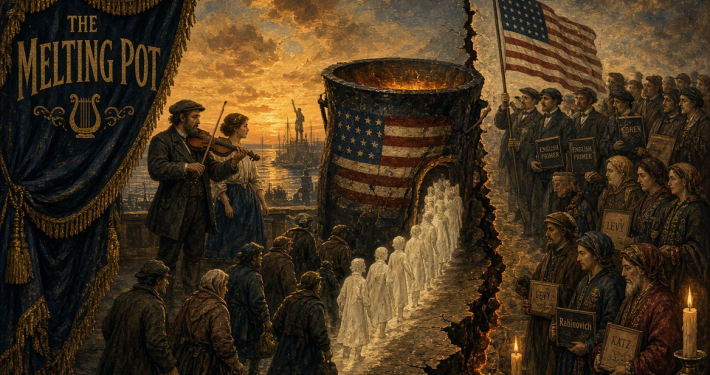
The Melting Pot
The Play That Changed America

The Play That Changed America
The phrase did not start in a statute. It started on a stage. In 1908 a London-born Jewish playwright put a Russian Jewish violinist on a New York rooftop and had him call America God’s crucible. The line walked out of the theater, into schools and factories, and by the 1920s it was the official story of what an immigrant was supposed to become. Then Congress put a lid on the pot.
Whether America is a pot that dissolves the old world, or a country that keeps the names, faiths, and tongues that walked in, is the fight the play started and never finished.
Israel Zangwill was born in London on January 21, 1864, and died there on August 1, 1926. He was the son of Jewish immigrants from the Russian Empire. He made his name in the 1890s with Children of the Ghetto, a portrait of London’s East End. He was also a Zionist — a delegate at the early congresses — and then a splitter. When Theodor Herzl entertained a temporary Jewish homeland in East Africa, Zangwill formed the Jewish Territorial Organization and spent years hunting for any land that would take Jews out of the pogrom belt. He wrote novels, essays, and plays. The Melting Pot is the one the United States kept.
He was not an American. The most quoted sentence about the American type was written by an English Jew who never emigrated.
The Melting Pot is a drama in four acts. It opened at the Columbia Theatre in Washington on October 5, 1908. Theodore Roosevelt was in the house with Mrs. Roosevelt, Secretary of State Elihu Root, and Oscar Straus, the Secretary of Commerce and Labor and the first Jewish cabinet member. Accounts of the night say Roosevelt leaned forward at one speech and said, in a voice the house could hear, “That’s all right,” and at the curtain called down that it was a great play. The next day he sent for Zangwill. The New York Times of October 10, 1908, reported that the president disliked the play’s attack on the American family and the divorce question, and that Zangwill came back from a White House lunch “crestfallen.” The immigration sermon he left alone.
The New York opening was at the Comedy Theatre on September 6, 1909, produced by Liebler & Company and staged by Hugh Ford. It ran 136 performances. It also played Chicago and London. Critics in New York were cooler than the Washington opening night. The title was not. A later line, often credited to the New York Herald-Tribune in 1926, said seldom had an author molded thought with a single phrase.
The metaphor itself was older. Ralph Waldo Emerson had written in 1845 of a “smelting pot” in which Europeans would mix. A magazine piece in 1876 used “melting pot.” Zangwill did not invent the image. He made it the national one. The play was billed as a drama of the amalgamation of races.
David Quixano is a Russian Jewish composer. He has survived the Kishinev massacre of 1903, in which his mother and sister were killed. He comes to New York to his uncle Mendel and writes an “American Symphony.” He wants to forget the old world, not remember it. He falls in love with Vera Revendal, a Russian Christian settlement worker. The turn of the plot is that her father, a Russian baron, commanded the troops at Kishinev. The feud of the old country walks into the new one. David breaks with her, then comes back. The play’s answer is that America is the place where that blood debt can be burned off.
The speech that Roosevelt heard, and that the country kept, is David’s:
America is God’s Crucible, the great Melting-Pot where all the races of Europe are melting and re-forming! Here you stand, good folk, think I, when I see them at Ellis Island, here you stand in your fifty groups, with your fifty languages and histories, and your fifty blood hatreds and rivalries. But you won’t be long like that, brothers, for these are the fires of God you’ve come to — these are the fires of God. A fig for your feuds and vendettas! Germans and Frenchmen, Irishmen and Englishmen, Jews and Russians — into the Crucible with you all! God is making the American.
He tells his uncle the real American has not arrived yet. He is only in the crucible. He will be the fusion of all races, “the coming superman.”
The last scene is the sunset over the harbor. David names the pot: Celt and Latin, Slav and Teuton, Greek and Syrian, black and yellow. Vera adds, “Jew and Gentile.” He goes on: East and West, North and South, the palm and the pine, the crescent and the cross — “how the great Alchemist melts and fuses them with his purging flame.”
That is the whole theory. Europe’s races go in. A new man comes out. The old names, the old feuds, and the old faiths are the slag.
Zangwill’s pot is Europe. The list in the famous speech is Germans, Frenchmen, Irishmen, Englishmen, Jews, Russians. The sunset speech widens the list — Syrian, black and yellow, crescent and cross — but the play’s engine is a Jewish-Christian marriage that cancels a Russian pogrom. It is not a theory of Africa, Asia, or the Western Hemisphere. Later speakers stretched the metaphor until it covered everyone. The 1908 text did not.
It is also a theory of forgetting. David’s symphony is the opposite of a memorial. The past is the thing the fire is for. Horace Kallen, the philosopher who answered Zangwill with “cultural pluralism” in 1915, said the opposite: people do not melt, and a democracy is an orchestra of lasting groups, not a crucible. Randolph Bourne’s 1916 essay “Trans-National America” called the melting pot a failure that produced not a new race but a washed-out Anglo-Saxonism with the colors boiled out. Jane Addams and the settlement houses were closer to Zangwill in practice and further from him in theory. They taught English and civics. They did not ask the immigrant to stop being who he was on Saturday.
Jewish critics at the time were split. Some heard a plea to take in the survivors of Kishinev. Others heard an argument that the Jew should disappear into the Gentile by marriage. Zangwill, the Territorialist, wanted a land for Jews who could not stay in Russia. The same man wrote a play in which the American Jew’s future is to stop being separately Jewish. Both positions sit in his work. They do not agree.
After 1908 the phrase left the theater. Settlement houses, public schools, and factory English classes used it. The Bureau of Naturalization, created in 1906, and the Americanization drives of the First World War turned it into a program: night classes, citizenship pageants, flag drills, “one nation” pledges. The demand was loyalty in word, deed, and accent. The war and the Red Scare hardened it. A man who kept his old tongue and his old paper was treated as unfinished, or worse.
Roosevelt had already said the thing in other words. In “True Americanism” (1894) he wrote that the man who does not become Americanized fails to remain a European and becomes nothing at all — and in the same breath that it was necessary to keep out laborers who depressed wages and “races which do not assimilate readily with our own.” He could cheer Zangwill’s crucible and still want a gate. The play gave the cheer a slogan. It did not write the gate.
Henry Ford ran his own version. The Ford English School’s 1916 graduation pageant had workers walk into a great pot in national costume and walk out in identical suits waving flags. That is the metaphor made literal, and it is Ford’s, not Zangwill’s. The playwright had a symphony. The factory had a uniform.
The Emergency Quota Act of 1921 and the Immigration Act of 1924 (Johnson–Reed) did not repeal the metaphor. They rationed it. National-origin quotas were set from the 1890 census, then from the population already here, so that the stream would look like the country of the older stock: northern and western Europe large, southern and eastern Europe small, Asia shut. The pot was still the official picture in the schoolbook. The law said how many could enter the pot, and from where.
Zangwill died in 1926, two years after the act. The phrase outlived him. It is still the short answer Americans give when they are asked what the country is. It is also still the answer other Americans reject. Kallen’s orchestra, Bourne’s federation of nationalities, and the later “salad bowl” and “mosaic” are all replies to one rooftop speech in a 1908 play.
The play said God was making the American out of Europe’s races, and that the old feuds would not survive the fire. The country that heard it built Americanization classes on that hope, and then, in 1924, wrote the numbers down. The argument the play started — dissolve, or keep the names — is the argument the law has been having ever since.
 EAB Radio Network
 EAB Radio NetworkHow Are They Destroying America?