American English is a Germanic language, and it is not the English of London or of Toronto.

American English is a Germanic language, and it is not the English of London or of Toronto.
Canada dates from Confederation in 1867. Mexico’s independence was consummated in 1821.. The English-speaking country that became the United States begins at Jamestown in 1607, about 420 years ago, or at independence in 1776. The language argument does not need the round numbers. American English is a West Germanic language, and it is not the English of London or of Ottawa.
America’s language is American English. It is a West Germanic language, carried here by English settlers after 1607, altered by isolation, by Webster, by later European migrations, and by three centuries of life that London did not share. It is not a dialect that failed to keep up with Britain. It is the speech of a people who stopped being provincial Britons and did not become Canadians.
Canada became a dominion on July 1, 1867, when the British North America Act united the Province of Canada, Nova Scotia, and New Brunswick. That is about 160 years ago. Full legislative independence from Britain came later, with the Statute of Westminster in 1931 and the patriation of the constitution in 1982. Canada is a federal parliamentary monarchy. It did not fight a war of separation against the Crown.
Mexico’s war of independence began with the Grito de Dolores in 1810 and was consummated in 1821, when the Treaty of Córdoba ended Spanish rule. That is a little over 200 years ago. The Spanish conquest of the Aztec capital was in 1521. Three centuries of viceroyalty sit between that date and the Mexican republic. Mexico’s national language is Spanish.
The English political nation on this coast begins at Jamestown in 1607. Independence was declared in 1776. From 450 years, the Spanish town at St. Augustine, which is a different story and a different language but the relevant span for American English is the English span: four centuries of speech, two and a half of them inside an independent republic.
It is that three countries in North America standardized three different official inheritances. Canada kept English and French, and kept a British spelling. Mexico kept Spanish. The United States kept English and then revised it.
English is West Germanic. Its nearest relatives are Frisian and, a step further off, Dutch and Low German. The core vocabulary of the house, the farm, the family, and the strong verbs is Germanic. The Norman Conquest after 1066 poured in French, and the Renaissance poured in Latin, so a modern page looks half Romance. The grammar did not become French. Word order, the weak verb, the pronouns, and the plain style of a statute are still Germanic.
American English inherited that whole stack. It did not switch families. A sentence of Jefferson’s is built like a sentence of Burke’s, and both are built like a sentence that would have been impossible in Spanish or in a Native language of the Atlantic coast. The claim that American English is Germanic is true. It is also true of British English. The split is inside the family, not a change of family.
What the split produced is a standard. American English has its own spellings, its own pronunciations, its own public vocabulary, and its own literary center. Canadian English sits between the two, closer to American speech in the mouth and closer to British practice on the page. Mexican Spanish is a separate language. The three outcomes match the three political histories.
The settlers at Jamestown and Plymouth spoke the English of their day, which was still rhotic. The r after a vowel was pronounced. Non-rhotic speech, the dropped r of later Received Pronunciation, spread in southern England in the eighteenth century, after the main colonial planting. John Walker, in London, was already noting card as something like “caad” by 1791. Most of North America never made that change. The r in hard, farm, and more stayed. New England and the coastal South later took on some non-rhotic speech from continued contact with Britain. The general American standard did not.
That is the clearest single sound difference, and it is a retention, not an invention. Americans kept an older English r. Britain, in its prestige dialect, dropped it. The colony was not behind. The metropole moved.
Other sounds moved the other way. The American father-bother merger, the cot-caught merger across much of the West and the Midlands, and the flattened vowels of the inland cities are American developments. So is the Northern Cities shift around the Great Lakes. A speaker from London and a speaker from Chicago can understand each other. They do not think the other is speaking the home standard.
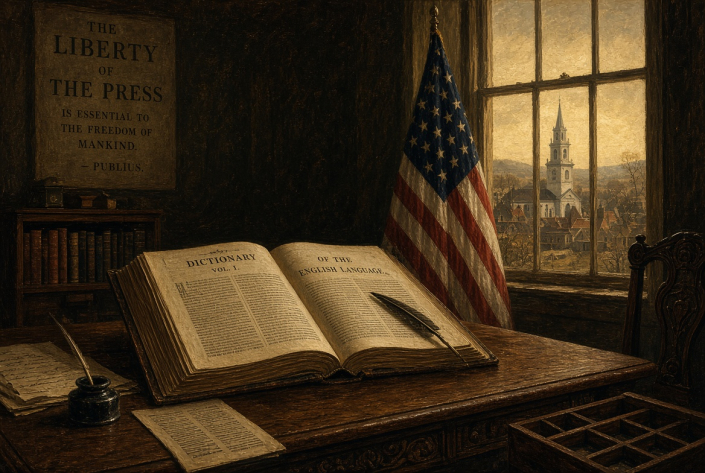
Noah Webster was explicit. In the decades after independence he argued that a separate nation needed a separate orthography and a separate dictionary. His American Dictionary of the English Language appeared in 1828. The spellings he pushed, and that American printers adopted, are the ones a British reader still marks as wrong: color for colour, honor for honour, center for centre, defense for defence, traveled for travelled, check for cheque in the banking sense. He also preferred -ize where London often kept -ise.
This was a political decision dressed as a spelling reform. Webster said American books should not look like London books. The schoolroom followed him. By the late nineteenth century a child in Ohio was taught a standard that would have been corrected in a school in Surrey. Canadian schools, for a long time, corrected toward Britain: colour, centre, and the rest, even while the children’s vowels were closer to Buffalo than to Bristol. The page is where Canada stayed imperial. The page is where the United States left.
A language splits in the lexicon when the life splits. The colonies named animals, plants, tools, and offices that England did not have, or named them differently.
Corn in America is maize. In Britain it is grain in general, usually wheat. Creek, bluff, squash, raccoon, moose, and hickory are American needs, several of them taken from Algonquian languages and naturalized into English. Store for a shop, fall for autumn, mad for angry, gotten as the past participle: several of these are older English that America kept and Britain dropped. Fall was ordinary English before autumn won the prestige contest in London. The colony again kept the older word.
Later European migrations added another layer without changing the grammar. Dutch gave cookie, boss, stoop, and waffle in the Hudson Valley. German gave sauerkraut, kindergarten, noodle, and a run of food words. Yiddish, in the cities, gave schlep, klutz, and chutzpah to the colloquial standard. Italian, Polish, and Scandinavian kitchens did the same. The public language remained English. The borrowings sat inside it the way French had sat inside English after 1066. A distinct vocabulary is not a separate language. It is evidence that the speakers had a separate life.
Canadian English is the nearest relative, and it shows what did not happen in the United States.
Canadians generally sound rhotic, like Americans, and a Great Lakes Canadian can be hard for an outsider to separate from a speaker in Michigan. The lexical exceptions are famous and small: zed for the letter, chesterfield in older speech for a sofa, toque, eh. The spellings, in schools and in the press, stayed British longer and still lean that way: colour, centre, theatre. The political reason is the one already given. Canada did not sever the crown. It confederated inside the empire and kept the imperial page.
American English standardized against that choice. A U.S. stylebook that prints colour is making a point. A Canadian stylebook that prints color is also making a point. The difference is not large enough to block a conversation. It is large enough to mark a border. Ethnic Americans, if that name is going to be used for the pre-1965 European-descended stock and the nation they built, have a linguistic marker that is not the King’s English and not the compromise north of the lakes.
American English is not one accent. New England, the inland South, Appalachia, the Midland, the West, and African American English are all audible. The claim is not that a fisherman in Maine sounds like a rancher in Montana. The claim is that they share a national standard against which the accents are heard as American.
That standard was built in the nineteenth century by spellers, newspapers, and the common school. Webster’s blue-backed speller sold in the millions. The McGuffey readers carried a national prose into towns that had no theater and no university. Immigrants from Germany, Ireland, Italy, and eastern Europe learned this standard in the public school, not the standard of the BBC, which did not yet exist, and not the standard of their parish. The grandchild spoke American English even when the grandfather did not. That is how a stock becomes a people in the one medium that every institution uses.
The same school did not produce British English. It did not produce Canadian English. It produced the variety in which the laws, the papers, and the ordinary book are written in the United States.
American English is the language of the country, not the private property of one ancestry. Enslaved Africans and their descendants shaped the spoken language, especially in the South, and their English is one of the great American varieties. Later arrivals learned the standard and altered the colloquial layer. The Fourteenth Amendment and the naturalization oath do not include a pronunciation test.
The historical point is narrower. The standard was fixed by a population of European descent, over generations, in institutions those generations built, and it came out different from the standard those generations had left. A Germanic grammar, an older set of r’s, a reformed spelling, and a lexicon of the American land and the American office: that is a national language in the only sense a language of this family can be national. It is mutually intelligible with British English. It is not the same standard, and the speakers have not treated it as the same standard since Webster.
Canada’s confederation dates from 1867. Mexico’s independence dates from 1821. The English founding on this coast dates from 1607, and the republic from 1776. The language of the republic is American English, a West Germanic language that kept the rhotic r, reformed the spelling, and filled its dictionary with the life lived here. Canadian English is the intermediate case, American in much of the mouth and British on much of the page. The difference is the political difference. One country left the empire and standardized the leaving. The other did not.
That standard is one of the things that makes the pre-1965 European-descended population, mixed across the old national lines, a people rather than a set of expatriate colonies. They did not go on speaking the English of the counties they had left. They spoke, and taught their children to speak, the English of the country they had made.
 EAB Radio Network
 EAB Radio NetworkThe Destruction of Ethnic America
