
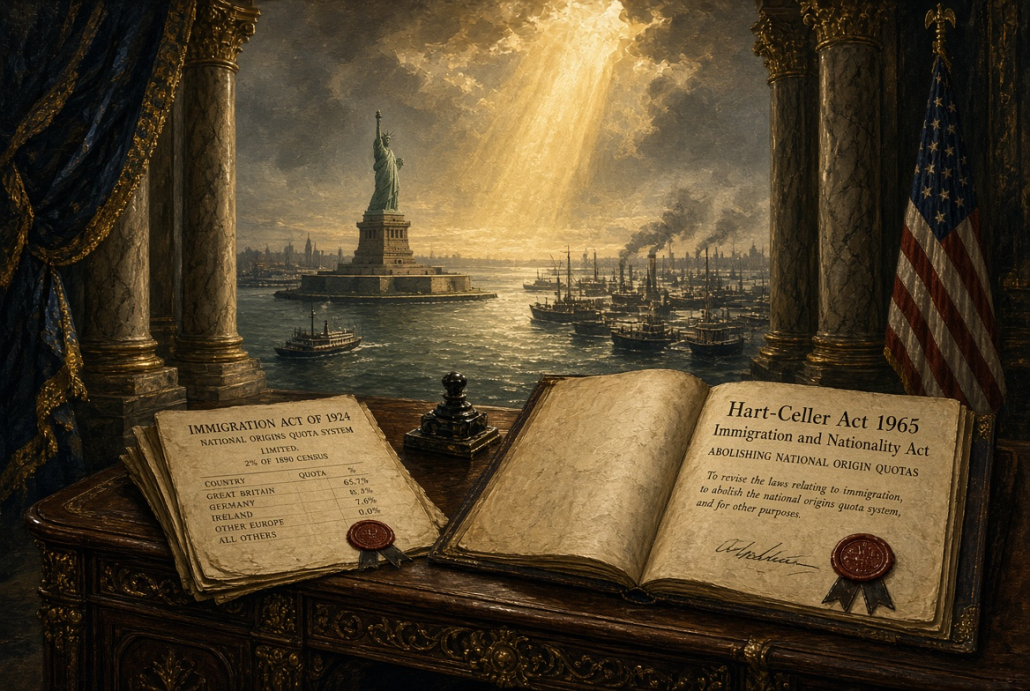

The Hart–Celler Act of 1965
Immigration and Nationality Act of 1965 · Public Law 89-236 · H.R. 2580
What it is
Immigration and Nationality Act of 1965 (Hart–Celler Act)
Public Law 89-236. Signed by Lyndon B. Johnson, October 3, 1965, at Liberty Island. Effective June 30, 1968, for the Eastern Hemisphere system; Western Hemisphere numerical cap followed in 1976 (and was folded into a worldwide cap in 1978).
This is the statute that replaced the national-origins quota machine McCarran–Walter had left standing. It changed who could get a visa, not the naturalization exam.
Sponsors and floor management
House: Rep. Emanuel Celler (D-NY), chair of Judiciary, the name on the House bill.
Senate: Sen. Philip A. Hart (D-MI).
Senate floor: Sen. Edward M. Kennedy (D-MA).
White House: Johnson, carrying a Kennedy-administration draft that had stalled in 1963–64.
What it struck out
The national-origins formula (1921 emergency quota → 1924 Johnson–Reed → 1952 INA Title II). That formula had assigned most slots to Northern and Western Europe by 1920-census math. Hart–Celler dumped the country-by-country ethnic allotment.
What it put in its place
A preference grid, not an open door:
- Family-sponsored preferences (the engine later called chain migration): unmarried children of citizens; spouses and children of LPRs; married sons/daughters of citizens; siblings of citizens.
- Employment preferences: members of the professions and scientists/artists of exceptional ability; skilled and unskilled workers in short supply.
- Refugees (then a small preference; later pulled into separate refugee law in 1980).
- Per-country cap (originally 20,000 for Eastern Hemisphere countries).
- Labor certification for most job-based visas (Department of Labor must find no willing, able U.S. worker).
Immediate relatives of U.S. citizens (spouses, minor children, parents of adult citizens) were put outside the numerical cap. That is why family numbers could grow without a hard annual lid on that class.
Hart–Celler is the October 3, 1965, rewrite of the admissions half of the Immigration and Nationality Act. President Lyndon B. Johnson signed it on Liberty Island, under the Statue of Liberty, with the Manhattan skyline behind him. It did not rewrite the naturalization exam. McCarran–Walter (1952) still supplied the oath, the five-year wait, English, civics, and the rule that race and sex could not bar naturalization. Hart–Celler changed who could get in line, and in what order.
The name on the statute is the two sponsors: Senator Philip A. Hart of Michigan and Representative Emanuel Celler of New York. The man who managed it on the Senate floor was Edward M. Kennedy of Massachusetts. The man who forced the clause that actually moved the numbers was Representative Michael A. Feighan of Ohio. The president who signed it was Johnson. The president who had sent the first draft, in July 1963, was John F. Kennedy, dead twenty-two months by signing day.
It is an amendment to the 1952 code, not a new country. Title 8 still sits on McCarran–Walter. Hart–Celler is the door.
The system it replaced
From 1921 (emergency quota) and 1924 (Johnson–Reed) through 1952, admission was rationed by national origins. The formula used the 1890 census, then the 1920 census, to hand most visas to the countries that had stocked the country already: Britain, Ireland, Germany, Scandinavia. Southern and Eastern Europe got thin slices. Asia was near shut — the Chinese Exclusion residue, the Asiatic Barred Zone, then the Asia-Pacific Triangle. The Western Hemisphere was largely outside the quota, which is why Mexican and Canadian movement had a different legal path.
The stated purpose in 1924 was continuity of the existing people. The House committee report and the floor speeches of that year said the country was entitled to prefer the stocks it already had. That is not a later invention. It is what the statute’s authors wrote down.
By the late 1950s that statute was politically naked. It insulted allies. It insulted the governments Washington was trying to keep out of the Soviet column. Italian, Greek, Polish, and Jewish organizations in the big cities had been calling it a slur on their parents for forty years. The civil-rights statute of 1964 had just told the country that race was an illegitimate sorter inside the gates. The same Congress was asked why birthplace was still a legitimate sorter at the gate.
That is the history that brought the bill. Not a cipher in a 1925 European pamphlet. A domestic fight that had been running since Celler’s first term, joined in 1963–65 to the civil-rights majority and to Cold War embarrassment.
Start: who had been pushing, and for how long
Emanuel Celler (1888–1981) is the long thread. Born in Brooklyn. Parents were Jewish immigrants from Germany. He grew up in the Jewish neighborhoods of Brooklyn and Manhattan, practiced law, and entered the House in 1923 as a Democrat — one year before Johnson–Reed. His maiden fight, and Johnson’s signing speech forty-two years later still named it, was against national-origins quotas. He chaired or sat atop Judiciary for most of the middle of the century. In 1952 he tried to beat McCarran–Walter and lost. He kept filing shorter and shorter bills. By 1965 the bill that bore his name was thin on purpose: kill the national-origins formula, leave the rest of the code standing. Religion: Jewish. Ethnicity: Ashkenazi Jewish, German-Jewish immigrant stock, American-born. District: Brooklyn, already a multi-ethnic city seat. He did not retire in triumph with a destruction speech. He lost his 1972 primary to Elizabeth Holtzman, a younger Democrat, after half a century in the House. He died in 1981. His public line, from the 1920s to the signing, was that national origin was an insult and an error, not that he had come to unmake the American people.
Philip Aloysius Hart (1912–1976) is the Senate name. Born in Bryn Mawr, Pennsylvania, into an Irish Catholic family. Georgetown, then Michigan Law. Army in the Second World War, wounded. Michigan lieutenant governor, then senator from 1959 until he died of cancer in office in 1976. Catholics and labor knew him as the “conscience of the Senate.” He co-sponsored civil-rights bills and this one. His stated reason, on the record, was that “theories of ethnic superiority” should not be the basis of the admissions law. He did not leave a boast that he had finished the country. He died in the seat.
Edward Moore Kennedy (1932–2009), floor manager. Youngest son of Joseph P. Kennedy. Irish Catholic, Boston, Harvard, the family that had spent a generation climbing out of “No Irish Need Apply” and into the Senate. His brother John had chaired the immigration subcommittee as a senator and had called the quota “intolerable” and, in A Nation of Immigrants (1958, expanded later), an indefensible preference. After Dallas, Ted took the subcommittee and the floor. His motive on the page is the family line plus the civil-rights frame: national origin as a cousin of Jim Crow. He stayed in the Senate until his death in 2009 and kept working immigration bills, including the 1986 amnesty. He never delivered a valedictory that he had destroyed the republic. What he delivered, in 1965, was a list of things the bill would not do. That list is the quote that matters, and it is below.
Lyndon Baines Johnson (1908–1973), signer. Texas. Disciples of Christ, the frontier Protestant denomination of his mother and his hill-country towns. Not an immigration theorist. He wanted the bill as the third panel of 1964–65, after the Civil Rights Act and the Voting Rights Act, and he wanted it quiet. His signing speech is a downplay, not a fanfare of replacement.
John F. Kennedy wrote the 1963 message and never saw the statute. Irish Catholic, same family. The bill that passed is not identical to the bill he sent. The difference is the point of the whole story.
Robert F. Kennedy, attorney general in 1964, senator from New York by the signing. Irish Catholic. He told a House panel the Asia-Pacific Triangle might send about 5,000 the first year “after which immigration from that source would virtually disappear.”
Hubert Humphrey, vice president, at the ceremony. Midwestern Protestant, civil-rights Democrat. His line: the 1964 Act had removed second-class citizenship at home; 1965 should remove the suggestion of second-class peoples at the gate.
Everett Dirksen, Senate minority leader, Illinois Republican, Protestant, the man who had helped break the civil-rights filibuster. He helped this one too. Jacob Javits, New York Republican, Jewish, liberal, city machine and business, a yes. Mike Mansfield, majority leader, Montana, a yes.
Michael A. Feighan (1905–1992) is the man the short versions skip. Irish Catholic, Cleveland Democrat, chairman of the House immigration subcommittee, more restrictionist than Celler. He sat on the bill until the White House bargained. His price was to flip the preference order. The original Hart–Celler draft, and the Kennedy draft, put skills first — people “especially advantageous” to the country. Feighan and the members who feared an Asian and African skilled inflow forced family reunification into the top slots. Their theory, said out loud, was that family ties would keep the stream European, because that is who already had relatives here. Celler accepted the flip to get the bill out of Feighan’s subcommittee. The clause that later produced chain migration was written by the side that thought it would prevent the shift.
That is the middle of the story. The men who wanted a universal door, and the men who wanted the old country kept, cut a deal. The deal did the opposite of what the second group predicted, and it did more than the first group told the floor it would do.
Who they were, without the cartoon
The pen and the gavel were not one ethnicity and not one church.
- Celler: American-born Jew of German-Jewish parents, Brooklyn Democrat, forty-year opponent of the 1924 formula.
- Hart: Irish Catholic, Pennsylvania-born, Michigan senator, civil-rights Democrat.
- The Kennedys: Irish Catholic, Boston, presidential family, carrying a 1958–63 argument that national origin was an insult.
- Johnson: Texas Protestant, Disciples of Christ, signer, downplayer.
- Feighan: Irish Catholic, Cleveland, the restrictionist who inserted family preference.
- Dirksen: Illinois Protestant Republican, leadership yes.
- Javits: New York Jewish Republican, yes.
- Humphrey: Protestant, vice president, civil-rights frame.
The roll call is the rest of the picture. Senate 76–18. House, depending on the journal line, 320–70 or 324–101 on the version reported; the enrolled bill cleared both houses by wide margins in September 1965. About three-quarters of Democrats and about 85 percent of Republicans voted yes. The noes clustered in the South: Sam Ervin of North Carolina, Strom Thurmond, Robert Byrd, and a bloc of Southern Democrats who said in debate that equalizing Ethiopia with England would change the country. Ervin’s line was blunt. He did not claim a secret plot. He claimed a foreseeable result.
A bill that passes with Dirksen and the Senate Republican conference is not a single-synagogue operation and not an Irish revenge plot. It is a 1965 majority, built on civil rights, Cold War face, urban ethnic lobbies that had been shorted in 1924, and a compromise that both sides misread.
What they actually said — the brag that is on paper
They did not retire to a line about mission accomplished and a ruined country. That sentence is not in the Congressional Record, not in Johnson’s signing text, not in Celler’s papers as a confession, not in Hart’s last interviews. It circulates as a meme. It is not a document. What they bragged about is the opposite, and the opposite is more useful, because the outcome walked away from the brag.
Johnson, October 3, 1965, Liberty Island:
“This bill that we will sign today is not a revolutionary bill. It does not affect the lives of millions. It will not reshape the structure of our daily lives, or really add importantly to either our wealth or our power.”
He called the national-origins system “a cruel and enduring wrong” and “un-American,” and he said the days of unlimited immigration were past. People would come “because of what they are, and not because of the land from which they sprung.”
Kennedy, Senate floor, as floor manager, the passage that has been reprinted for sixty years:
“First, our cities will not be flooded with a million immigrants annually. Under the proposed bill, the present level of immigration remains substantially the same. … Secondly, the ethnic mix of this country will not be upset. … Contrary to the charges in some quarters, [the bill] will not inundate America with immigrants from any one country or area, or the most populated and deprived nations of Africa and Asia. … In the final analysis, the ethnic pattern of immigration under the proposed measure is not expected to change as sharply as the critics seem to think.”
He also said it would not relax admission standards and would not throw American workers out of jobs, and that the country was not being asked to take subversives, criminals, illiterates, the contagious, or likely public charges.
Celler, House, August 25, 1965:
“The thrust of this bill is no appreciable increase in numbers. … With the end of discrimination due to place of birth, there will be shifts in countries other than those of northern and western Europe. Immigrants from Asia and Africa will have to compete and qualify in order to get in, quantitatively and qualitatively, which, itself will hold the numbers down. There will not be, comparatively, many Asians or Africans entering this country. … Since the people of Africa and Asia have very few relatives here, comparatively few could immigrate from those countries because they have no family ties in the United States.”
Robert Kennedy, 1964, on the Asia-Pacific Triangle: about 5,000 the first year, then the stream would “virtually disappear.”
Senator Hiram Fong of Hawaii, a supporter answering the Asian-flood question: Asians were six-tenths of one percent of the population; Japan might send a few thousand over five years; that part of the world would “never reach 1 percent.”
That is the brag. Not “we have destroyed America.” “The ethnic mix will not be upset. The numbers will not jump. Asia and Africa have no relatives here, so they cannot come in bulk.”
The restrictionist side said the reassurance was wrong. They lost the vote. They were not crazy about the mechanism. They were right about the direction, wrong about how fast, and they had themselves helped install the family grid that proved them right.
Middle: what the statute actually did
Signed October 3, 1965. Eastern Hemisphere system effective June 30, 1968. A worldwide system came later.
Struck:
- The national-origins quota.
- The Asia-Pacific Triangle.
Installed:
- A preference system. Family first, after Feighan’s flip: unmarried sons and daughters of citizens; spouses and unmarried children of permanent residents; married sons and daughters of citizens; brothers and sisters of citizens. Then employment preferences. Then a small refugee slice, later pulled out by the 1980 Refugee Act.
- Immediate relatives of citizens — spouses, minor children, parents of adult citizens — outside the numerical cap. That uncapped class is why family numbers could grow without a hard lid.
- A per-country ceiling, first 20,000 for Eastern Hemisphere countries, so one nation could not take the whole pool.
- Labor certification for most job visas.
- A Western Hemisphere cap of 120,000, added late to calm the members who saw Mexico and the rest of the Americas as the real door. In 1976 the hemisphere was brought under the same per-country rule. In 1978 the two hemispheres were folded into one worldwide ceiling.
What it did not do: it did not grant citizenship on arrival, did not repeal the 1952 naturalization rules, did not legalize people already here unlawfully, did not abolish the border. It rebuilt the visa queue.
The designers’ error, visible in Celler’s own sentence, was mathematical. Family preference reproduces the last cohort of immigrants. If the first new cohorts are no longer British and German, the next cohorts are their brothers, then their brothers’ spouses, then the spouses’ parents and siblings. A rule written to freeze Europe, once any non-European cohort is inside, freezes nothing. It copies the new cohort. That is chain migration as arithmetic, not as a slogan.
End: what happened after the signature
Johnson said it would not affect the lives of millions. Pew’s 2015 reconstruction, the standard census-based scoreboard, is the answer to that sentence.
In 1965 the country was about 84 percent non-Hispanic white, 11 percent black, 4 percent Hispanic, under 1 percent Asian. In 2015 it was about 62 percent white, 12 percent black, 18 percent Hispanic, 6 percent Asian. Pew’s counterfactual: without post-1965 immigration and the children of that immigration, the 2015 country would have been about 75 percent white. Immigrants and their U.S.-born children accounted for 55 percent of population growth from 1965 to 2015. The foreign-born share, which had been falling for decades and sat near a historic low in 1970, turned and climbed. Europe stopped being the source. Latin America and Asia became the source.
That is not a theory. It is the Census, read by Pew, set next to the floor speeches.
Later statutes bolted onto the same frame, they did not replace it:
- 1976 — Western Hemisphere under per-country caps.
- 1978 — one worldwide ceiling.
- 1980 — Refugee Act, a separate refugee number.
- 1986 — IRCA, the Simpson–Mazzoli amnesty, signed by Reagan; employer sanctions that were barely enforced. Kennedy was in that fight too, and again said the number would be limited and the border would be secured after.
- 1990 — higher caps, diversity visas.
- 1996 — IIRIRA, removal bars, the enforcement statute that never matched the admissions statute.
Celler was out of Congress by 1973. Hart was dead by 1976. Johnson was dead by 1973. Kennedy lived to see the result and spent the rest of his career defending and extending the system, not disowning it. He did not say he had destroyed the country. He said, into the 2000s, that the system was broken and needed another bill. That is a different sentence from a confession, and it is the sentence he actually gave.
No principal stood up, retired, and said “mission accomplished, I destroyed America.” If that line is in a post, it should be marked as a claim without a document. The document that exists is the 1965 reassurance, and the census that falsified it.
Why this, in this decade
Three pressures, all on the record.
Civil rights. 1964 had made race an illegitimate domestic sorter. National origin was close enough, in that Congress, to be treated as the same sin. Humphrey said so in one breath.
Cold War. A quota that called some allies higher stock and some allies lower stock was a gift to Moscow’s pamphlets. Celler had been saying “gratuitous insult” for years. The State Department wanted the insult gone.
The 1924 losers, organized. Italian, Greek, Polish, Jewish, and some Slavic organizations were not asking for a theory of the human race. They were asking for their cousins, shut out or stalled while Britain and Ireland’s unused quotas sat empty. Family preference, once flipped to the top, was their mechanism. They were not crazy to want it. It did what they wanted, and then it did not stop where they, or Celler, said it would stop.
A fourth pressure is internal Democratic politics. The Southern noes were the old party. The yeses were the new one: cities, unions, Catholics, Jews, blacks, and a Republican leadership that did not want to be the party of Ervin on this vote. The same Congress that passed Voting Rights passed this. They were in a mood to strike origin-tests. They were not in a mood to read a fifty-year fertility-and-sponsorship table.
What it did not change
Naturalization stayed the 1952 rules: LPR status first, five years (three if married to a citizen), physical presence, good moral character, attachment to the Constitution, English and civics, oath. Hart–Celler is an admissions statute. Section 311 of 1952 still governs race-and-sex on the oath.
What sponsors said it would not do
Kennedy on the Senate floor, 1965: the bill would not flood the country, would not change the ethnic mix in any meaningful way, would not let in millions, would not cause American workers to lose jobs. Celler and administration witnesses said the same. Johnson’s signing remarks framed it as ending an “un-American” quota, not as a population project.
What the numbers did after
Pew’s 2015 reconstruction is the standard census-based scoreboard: from 1965 to 2015, immigrants and their descendants accounted for 55 percent of U.S. population growth. Without post-1965 immigration the 2015 country would have been about 75 percent non-Hispanic white; with it, about 62 percent white, 18 percent Hispanic, 6 percent Asian (Black share little changed by this channel). Source regions flipped from Europe to Latin America and Asia. That is a change in who could enter and sponsor, not a change in the civics test.
Later bolts on the same frame
- 1976: Western Hemisphere brought under per-country caps.
- 1980 Refugee Act: refugees taken out of the preference pie.
- 1986 IRCA: amnesty plus employer sanctions.
- 1990 IMMACT: higher overall caps, diversity lottery.
- 1996 IIRIRA: removal and unlawful-presence bars.
The 1965 Act is still the skeleton those laws hang on. McCarran–Walter wrote the modern naturalization code and kept the old quota door. Hart–Celler left the code and rebuilt the door.
Direct Quotes From the Congressional Record: Yay’s & Nays
House: H.R. 2580, Aug. 25, 1965. Senate: same bill, mid-September. Conference report: Sept. 30. Votes: House passage about 318–95 (journals also list 320–70 / 324–101 on related tallies); Senate 76–18.
YEA — the bill will not change the country
Sen. Edward M. Kennedy (D-MA)
Senate Immigration Subcommittee, Feb. 10, 1965, and the floor line reprinted from that fight:
“Out of deference to the critics, I want to comment on … what the bill will not do. First, our cities will not be flooded with a million immigrants annually. Under the proposed bill, the present level of immigration remains substantially the same. … Secondly, the ethnic mix of this country will not be upset. … Contrary to the charges in some quarters, S. 500 will not inundate America with immigrants from any one country or area, or the most populated and economically deprived nations of Africa and Asia. … In the final analysis, the ethnic pattern of immigration under the proposed measure is not expected to change as sharply as the critics seem to think.”
“The bill will not flood our cities with immigrants. It will not upset the ethnic mix of our society. It will not relax the standards of admission. It will not cause American workers to lose their jobs.”
On the Asia-Pacific Triangle, same session, he called killing it “one of the most laudable aspects of the entire bill.” (111 Cong. Rec. 24,776.)
On assimilation fears:
“Another fear is that immigrants from nations other than those in northern Europe will not assimilate into our society. The difficulty with this argument is that it comes 40 years too late.” (111 Cong. Rec. 24,228.)
Rep. Emanuel Celler (D-NY)
House, Aug. 25, 1965, 111 Cong. Rec. 21,757–58 and 21,812:
“The thrust of this bill is no appreciable increase in numbers. … With the end of discrimination due to place of birth, there will be shifts to countries other than those of northern and western Europe. … since the people of Africa and Asia have very few relatives here, comparatively few could immigrate from those countries because they have no family ties in the United States. … no one can come without the individual certificate from the Secretary of Labor guaranteeing that the American workman will not be displaced. … few of them can even pay the cost of the ticket to come here. There is no danger whatsoever of an influx from the countries of Africa and Asia.”
“With the end of discrimination due to place of birth, there will be shifts in countries other than those of northern and western Europe. Immigrants from Asia and Africa will have to compete and qualify in order to get in, quantitatively and qualitatively, which, itself will hold the numbers down. There will not be, comparatively, many Asians or Africans entering this country. … Since the people of Africa and Asia have very few relatives here, comparatively few could immigrate from those countries because they have no family ties in the U.S.”
Opening the debate:
“The theory of national origins quota is antiquated, unworkable and unscientific. It was devised after World War I in an atmosphere of fear, almost of hysteria.”
Conference report, Sept. 30, 1965, p. 25,656:
“We need immigration in order to magnify the uses of our great resources.”
Celler’s Brooklyn story, used more than once (quoted at 111 Cong. Rec. in the civil-rights-and-immigration literature from the House debate):
“If you go to my district [in Brooklyn, New York] you will find people of all nationalities. … A man goes into a Chinese restaurant, and there, to his amazement, he sees a Negro waiter—a Negro waiter in a Chinese restaurant. And he says to the waiter, ‘What is the specialty of the house?’ And the Negro waiter says, ‘Pizza pie.’ ‘Pizza pie in a Chinese restaurant?’ And he said, ‘Yes, this is the Yiddish neighborhood.’ That gives you some idea of what is happening in this country and what is happening is good for the land because all those races are amalgamated and they are here for a good, common purpose, the weal and the welfare of our Nation, to which all these diverse races make contribution.”
Sen. Philip A. Hart (D-MI)
111 Cong. Rec. 24,238:
“Discriminatory provisions against immigrants from eastern and southern Europe, token quotas for Asian and African countries, and implications of race superiority in the Asia-Pacific triangle concept, have no place in the public policy of the United States.”
Hart’s line used throughout the year: theories of ethnic superiority must no longer be the basis of the admissions law.
Rep. Philip Burton (D-CA)
Aug. 25, 1965, p. 21,783:
“Just as we sought to eliminate discrimination in our land through the Civil Rights Act, today we seek by phasing out the national origins quota system to eliminate discrimination in immigration to this nation composed of the descendants of immigrants.”
Rep. Robert Sweeney (D-OH)
Aug. 25, 1965, p. 21,765:
“Mr. Chairman, I would consider the amendments to the Immigration and Nationality Act to be as important as the landmark legislation of this Congress relating to the Civil Rights Act. The central purpose of the administration’s immigration bill is to once again undo discrimination and to revise the standards by which we choose potential Americans in order to be fairer to them and which will certainly be more beneficial to us.”
Rep. Sidney Yates (D-IL)
same debate:
“I am aware that this bill is more concerned with the equality of immigrants than with their numbers. It is obvious in any event that the great days of immigration have long since run their course. World population trends have changed, and changing economic and social conditions at home and abroad dictate a changing migratory pattern.”
Sen. Hiram Fong (R-HI)
on whether Asia would change the country:
“Asians represent six-tenths of 1 percent of the population of the United States … with respect to Japan, we estimate that there will be a total for the first 5 years of some 5,391 … the people from that part of the world will never reach 1 percent of the population.”
Attorney General Nicholas Katzenbach
committee: the bill would not increase or accelerate arrivals by more than a small fraction.
Attorney General / Sen. Robert F. Kennedy
House subcommittee, 1964 (carried into the 1965 fight):
“I would say for the Asia-Pacific Triangle it [immigration] would be approximately 5,000, Mr. Chairman, after which immigration from that source would virtually disappear; 5,000 immigrants would come the first year, but we do not expect that there would be any great influx after that.”
Senate floor, answering Holland on “opening the doors wide,” Sept. 22, 1965, p. 24,779:
“The Senator talks about opening the doors wide. The doors are open only to those who can make a contribution.”
Rep. Henry B. Gonzalez (D-TX)
conference report, Sept. 30, p. 25,657, against the new Western Hemisphere cap:
“It seems as if we are erecting a wall, rather than reducing walls, which we originally intended to do.”
President Lyndon B. Johnson
signing, Liberty Island, Oct. 3, 1965 (not the Record of debate, but the official close of the fight):
“This bill that we will sign today is not a revolutionary bill. It does not affect the lives of millions. It will not reshape the structure of our daily lives, or really add importantly to either our wealth or our power.”
“The days of unlimited immigration are past. But those who do come will come because of what they are, and not because of the land from which they sprung.”
Vice President Hubert Humphrey
the civil-rights couplet used all year:
“We have removed all elements of second-class citizenship from our laws by the [1964] Civil Rights Act. We must in 1965 remove all elements in our immigration law which suggest there are second-class people.”
NAY — this is a radical departure
Sen. Sam J. Ervin, Jr. (D-NC)
The principal interrogator. He voted for the final bill after the Western Hemisphere cap was added, but the Record of his opposition to the original theory is the no-side’s spine.
“The people of Ethiopia have the same right to come to the United States under this bill as the people from England, the people of France, the people of Germany, [and] the people of Holland. With all due respect to Ethiopia, I don’t know of any contributions that Ethiopia has made to the making of America.”
Hearing, on a “fair” worldwide formula:
“If you are to be fair you would have to admit 83 Chinese to each Greek.”
On India after quotas fall:
“If my recollection is right, India has … at this time, about 450 million people. … Is anybody that gifted with enough prophetic foresight to foretell how many people from India are going to apply for admission to this country as immigrants when they are assured that we have abolished all discrimination by immigration laws?”
On who built the country:
“With all due respect to those who cast aspersions on it, the purpose is to bring to the United States people who have relatives here in a national origins sense, who have made contributions to our population and contributions to our development. I believe that we ought to give preference to those who have made such contributions to America and not put them on exactly the same basis as people who have made very little or no contribution to our population and no contribution to our development.”
On Greeks vs. a country he used as a foil:
“…as far as the people of Hellenic descent are concerned, it is much easier for the United States to assimilate 11% in new population each year if they come from the same nationalities which have contributed in a substantial manner to the population of the United States.”
And: people of Italy, Greece, and England “can be far more readily assimilated in our land and population than the people of Indonesia.”
Sen. Spessard L. Holland (D-FL)
Sept. 22, 1965, p. 24,779:
“What I object to is imposing no limitation insofar as areas of the earth are concerned, but saying that we are throwing the doors open and equally inviting people from the Orient, from the islands of the Pacific, from the subcontinent of Asia, from the Near East, from all of Africa, all of Europe, and all of the Western Hemisphere on exactly the same basis. I am inviting attention to the fact that this is a complete and radical departure from what has always heretofore been regarded as sound principles of immigration.”
Sen. John L. McClellan (D-AR)
same fight:
“Will the addition of still more minority groups from all parts of the world lessen or contribute to the increasing racial tensions and violence we are currently witnessing on the streets of our major cities?”
Sen. James O. Eastland (D-MS)
Judiciary chairman, floor opposition manager against Hart and Kennedy. The Deep South bloc voted no on final passage even after the hemisphere cap. His consistent line across McCarran–Walter and 1965: national origins as a mirror of who was already here.
Sen. Robert C. Byrd (D-WV)
Voted no. Recognized on the floor that Asian immigration would increase under the bill (111 Cong. Rec. 24,778–79 cluster with Holland).
Sen. Strom Thurmond (R-SC, then recently switched)
Voted no.
The McCarran–Walter defense that Ervin and Holland were still speaking in 1965, as paraphrased on the floor from the 1952 theory:
“The McCarran-Walter Act is … based on conditions existing in the U.S., like a mirror reflecting the United States.”
The feel of the room
The yea side talks like the Civil Rights Act: quota is Jim Crow at the gate; “accident of birth”; “second-class peoples”; Celler’s pizza-in-the-Chinese-restaurant story; Kennedy’s four “will nots.” They sound sure the numbers stay put because Africa and Asia have no uncles in Brooklyn.
The nay side talks like 1924 without always using 1924’s racial vocabulary. Ervin’s Ethiopia line, Holland’s “Orient … all of Africa … exactly the same basis,” McClellan’s street-violence question. They sound sure the door is being equalized on purpose, and that equalization is the revolution the sponsors deny.
Feighan of Ohio, who forced family preference to the top so the stream would stay the relatives of people already here, barely takes the floor on Aug. 25 — half a minute to say Dent’s objectives are in the amended bill. The mechanism that later moved the map is a committee deal, not a speech.
Similarities to Caracella Rome, A.D. 212 —
The Constitutio Antoniniana, 212 or early 213, is the edict of the emperor Marcus Aurelius Severus Antoninus, called Caracalla. It granted Roman citizenship to all, or almost all, free inhabitants of the empire who did not already have it. Ulpian records the grant. Cassius Dio, a senator who hated Caracalla, says the motive was money: more citizens meant more men liable for the inheritance tax and the manumission tax that fell on citizens. Modern historians do not throw Dio out. They add the rest. Citizenship had been widening for two centuries. Provincial elites were already Roman in law and habit. Caracalla, who had just killed his brother and co-emperor Geta, was also stitching a dynasty back together and playing at Alexander. The edict fits a fiscal need, a political need, and a long trend. It was not a recruitment drive to import foreign peoples into an empty Italy. The people it enfranchised were already living inside the borders.
What it did not do is end the empire in 212. The Western Empire falls in 476, two and a half centuries later, after the third-century crisis, the recovery under Diocletian and Constantine, the Christianization of the state, the split into East and West, and the armed migrations of Goths, Vandals, Suebi, and others in the fourth and fifth centuries — peoples who entered as armies and federates, not as visa applicants under a family grid. The East, same citizenship edict, same “mixing” in the loose sense, lasts until 1453. If 212 were a sufficient cause of collapse, Constantinople is the counterexample sitting on the same law.
The honest parallel to Hart–Celler is narrow. Both are status expansions justified in universal language. Both were sold, in part, as tidying a distinction that had become awkward. Both had a fiscal or political side-motive their authors did not lead with — Dio’s tax, Feighan’s relatives, Johnson’s civil-rights triptych. Both changed who counted as “us” in law. The dishonest parallel is the one that says Caracalla mixed the blood of Rome and therefore Rome died. He extended a legal status to people already there. Rome’s later military collapse is a different chapter, with its own dates. Use 212 as a warning about universalizing a status you used to ration, if that is the argument. Do not use it as a proof that a citizenship edict is a death sentence with a two-century fuse and a single cause.
Babel, and the biblical texts people reach for
Genesis 11 is the passage. The text says the whole earth had one language and one speech. They settle in a plain in Shinar, which later tradition calls Babylon. They say: let us build a city and a tower whose top is in the heavens, and let us make a name, lest we be scattered. The Lord comes down, says that as one people with one language nothing they propose will be withheld from them, confuses their language, and scatters them over the face of the earth. The city is left unfinished. The place is called Babel, because there the language was confused.
Read as written, the offense is not “immigrants.” The offense is a single people refusing the scatter, building a name and a tower so they will not be spread out. The divine act is the imposition of many languages and the scatter itself. Genesis 10, the table of nations, already sorts mankind by families, tongues, and lands; how a reader orders chapter 10 and chapter 11 is an old argument, but the text’s own moral in chapter 11 is anti-centralization, not an immigration statute.
Other passages get pulled into the same argument, and they should be named as themselves.
- Deuteronomy 32:8, in the reading many English Bibles give: the Most High divided the nations and set their bounds. Acts 17:26 has Paul say God made of one blood all nations and determined their appointed times and the bounds of their habitation. Those lines are about providence and limits, not about a 1965 preference grid.
- Ezra and Nehemiah, after the return from Babylon, are the closer “mixing” texts. The returned community is ordered to put away foreign wives. The stated fear is religious defection — the pattern of Solomon — not a census category. It is a covenant people under a law of endogamy, in a province of the Persian empire, rebuilding a temple. It is not a manual for a continental republic with a written constitution and a visa bulletin.
- Daniel’s Babylon is an imperial mixer of another kind: a conqueror who carries peoples off, renames the talented young, and feeds them the king’s meat. The faithful response in the text is refusal of the meat and the idol, not a theory of quotas.
- Revelation’s Babylon is a symbol of a world-city, proud, commercial, drunk on empire, marked for fall. Using it as a caption on Hart–Celler is a homiletic move. It is not what the chapter says.
A serious use of these texts in the post is this: the Bible’s nations are not treated as an accident, bounds are treated as real, a project to erase distinction and build one name is treated as pride, and a covenant people is told not to dissolve its worship into the surrounding cults. A careless use is this: Genesis 11 proves that a family-preference visa is the Tower, and Caracalla proves the visa will kill the state in the same way. The texts will not carry that load. They will carry a prior question the 1965 floor did not ask out loud — whether a people is allowed to prefer its own continuity, or whether “one language, one gate, one name” is the only moral option. The floor answered with the second, and promised the first would be untouched. The census answered the promise.
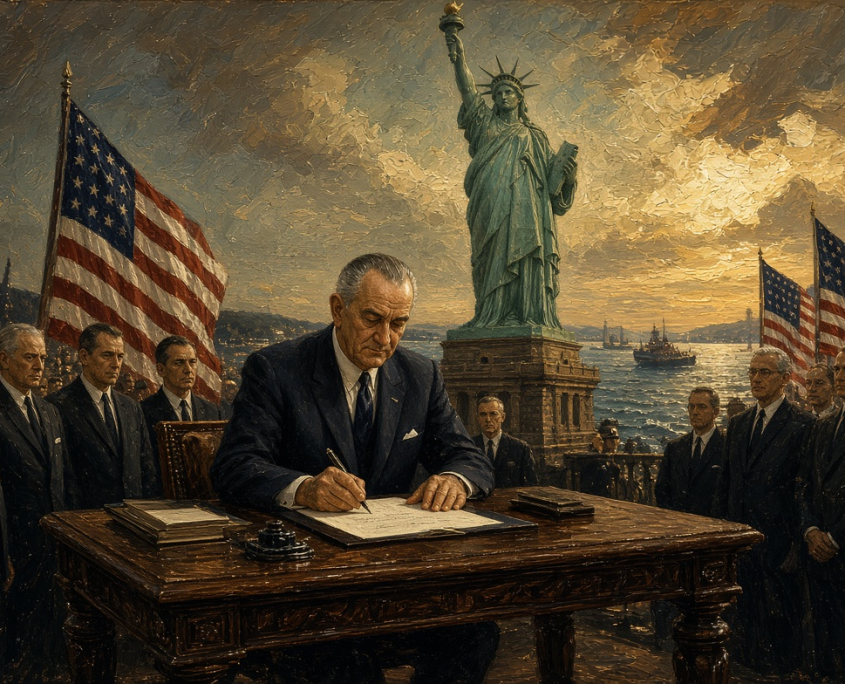
To Recap Hart-Celler
The Immigration and Nationality Act of 1965 (Hart–Celler Act)
Signed by President Lyndon B. Johnson on October 3, 1965, at the Statue of Liberty. It took full effect July 1, 1968. It is still the basic frame of legal immigration.
Who wrote and moved it
- House sponsor: Rep. Emanuel Celler (D-NY), longtime chairman of the House Judiciary Committee. He had fought national-origins quotas for decades.
- Senate sponsor: Sen. Philip A. Hart (D-MI).
- Senate floor manager: Sen. Edward M. Kennedy (D-MA).
- The Kennedy administration had sent a draft in 1963 (Attorney General Robert F. Kennedy; draft work associated with Adam Walinsky). After JFK’s death, Johnson made it part of the Great Society / civil-rights package.
- Passage was bipartisan: about 74% of House Democrats and 85% of House Republicans voted yes. Most no votes came from Southern Democrats.
What it replaced
From 1924 (and kept in the 1952 McCarran–Walter Act) the U.S. used the national-origins quota. Visas were apportioned from the 1920 census so most slots went to Northern and Western Europe. Asia was nearly closed. The Western Hemisphere had no numerical cap.
What the 1965 law did
- Abolished national-origins quotas.
- Barred visa discrimination by race, sex, nationality, place of birth, or residence.
- Set hemisphere caps at first: 170,000 Eastern Hemisphere (20,000 per country) and, for the first time, 120,000 Western Hemisphere.
- Later amendments (1976, 1978) made one worldwide cap (then 290,000) and a 7% per-country ceiling.
- Installed a preference system: roughly 75% family, 20% employment, 5% refugees.
- Immediate relatives of U.S. citizens—spouses, unmarried minor children, and parents of adult citizens—were exempt from the numerical cap. That exemption is what later drove volume.
- Family categories also included adult children and siblings of citizens (the “fifth preference”), which produced multi-generation chain sponsorship.
What sponsors said it would not do
Johnson: “not a revolutionary bill… It does not affect the lives of millions.”
Ted Kennedy: it “will not flood our cities with immigrants… will not upset the ethnic mix of our society… will not cause American workers to lose their jobs.”
Celler: few Asians or Africans would come because they had few relatives here.
Robert Kennedy told Congress Asia-Pacific inflows would be about 5,000 and then “virtually disappear.”
What happened to numbers
Lawful permanent residents were about 297,000 in 1965. From the mid-2000s onward the U.S. has typically issued on the order of about 1 million green cards a year. Immediate relatives outside the cap, plus family chains after naturalization, account for most of that growth. Employment-based immigration stayed the smaller share.
What happened to demographics
Pew Research (50-year mark, 2015):
| 1965 | ~2015 | |
|---|---|---|
| Non-Hispanic white | 84% | 62% |
| Hispanic | 4% | 18% |
| Asian | under 1% | 6% |
Pew’s counterfactual: without post-1965 immigration, the country around 2015 would have been about 75% white, 14% Black, 8% Hispanic, less than 1% Asian. New immigrants plus their U.S.-born children and grandchildren accounted for about 55% of U.S. population growth from 1965 to 2015.
Source regions flipped. In the 1950s more than half of immigrants were European and about 6% Asian. By the 1990s Europeans were about 16% of immigrants and Asians about 31%, with large increases from Latin America and Africa as well.
Hart–Celler did not itself write illegal-entry or modern asylum rules. It did replace a European-weighted quota with a family-weighted global system and left immediate relatives uncapped. That is the legal change; the demographic shift above is the measured result.
Opposition:
House Aug. 24–25 and Senate Sept. 16–17, 20–22, 1965. 111 Congressional Record.
Rep. Durward G. Hall (R-MO)
House, Aug. 25, 1965, 111 Cong. Rec. 21,776
“Yes, Mr. Chairman, we have sent Peace Corps personnel to the four corners of the world to teach new skills and modern scientific techniques in the underdeveloped nations which are literally starving for trained workers. Are we now to establish a program which will literally skim the cream off the very countries that desperately need new skills to emerge from the dark ages? Mr. Chairman, does it make sense at all to spend billions bringing new skills to the underdeveloped nations and at the same time initiating a new immigration policy that will draw the same skills from nations which need them far worse than we do?”
“Mr. Chairman, if we could eliminate political pressures and efforts to rally support from various pressure groups, this bill could not be passed. But surely we do not have to wipe out a good law just to prove our good intentions.”
“Look at a few samples. Australia, which has thousands of square miles of unsettled land, prohibits all nonwhites. Switzerland permits no immigrants. Argentina and Venezuela both exclude nonwhite immigrants. Some countries in Central America permit no Asiatics or Middle Easterners. … The United Kingdom has recently raised bars to its own colonial Negroes of the Caribbean areas. Yet we eliminate all. Wherefore goes consistency? The present law is more liberal than that of any other nation. We need not apologize for it. We should not repeal it, and I for one will not be a party to its demise.”
Rep. Maston O’Neal (D-GA)
House, Aug. 25, 1965, 111 Cong. Rec. 21,786
“Mr. Chairman, for too long our Nation’s foreign policy has been muddled by those who worry incessantly about what others think of us. Such a course has apparently resulted in more enemies than friends for the United States. Now, the shapers of our foreign policy propose that we liberalize our immigration laws to gain worldwide approval.”
Rep. O. Clark Fisher (D-TX)
House debate, same bill: opposed on the ground that the immigrant flow would come much too fast for the United States to absorb.
Sen. James O. Eastland (D-MS)
Senate floor, Sept. 22, 1965
He charged that doing away with national origins “catered to pressures of organized minority blocs in the great urban areas of this country.”
He denounced the bill as “politically-motivated.” He said it was an effort to “curry the favor of minority blocs of voters” through destruction of the national origins quota system. America, he said, should retain selectivity and restrictions on the character and origin of immigrants.
(Same day, JTA contemporaneous account of the floor; the “organized minority blocs” phrasing is also how later histories quote the Eastland-Thurmond line that the legislation was “an assault on immigration laws by those who ‘appeal to organized minority blocs in the great urban areas,’” the purpose being “to increase immigration and change its composition.”)
Sen. John L. McClellan (D-AR)
Senate, Sept. 22, 1965
The United States has “absolutely no business liberalizing its immigration laws.”
“Will the addition of still more minority groups from all parts of the world lessen or contribute to the increasing racial tensions and violence we are currently witnessing on the streets of our major cities?”
Sen. Spessard L. Holland (D-FL)
Senate, Sept. 22, 1965, 111 Cong. Rec. 24,779
“What I object to is imposing no limitation insofar as areas of the earth are concerned, but saying that we are throwing the doors open and equally inviting people from the Orient, from the islands of the Pacific, from the subcontinent of Asia, from the Near East, from all of Africa, all of Europe, and all of the Western Hemisphere on exactly the same basis. I am inviting attention to the fact that this is a complete and radical departure from what has always heretofore been regarded as sound principles of immigration.”
Sen. Sam J. Ervin, Jr. (D-NC)
Senate, Sept. 17, 1965, 111 Cong. Rec. 24,231–24,237, and the same fight through the 22nd
“The people of Ethiopia have the same right to come to the United States under this bill as the people from England, the people of France, the people of Germany, [and] the people of Holland. With all due respect to Ethiopia, I don’t know of any contributions that Ethiopia has made to the making of America.”
“If you are to be fair you would have to admit 83 Chinese to each Greek.”
“If my recollection is right, India has … at this time, about 450 million people. … Is anybody that gifted with enough prophetic foresight to foretell how many people from India are going to apply for admission to this country as immigrants when they are assured that we have abolished all discrimination by immigration laws?”
“With all due respect to those who cast aspersions on it, the purpose is to bring to the United States people who have relatives here in a national origins sense, who have made contributions to our population and contributions to our development. I believe that we ought to give preference to those who have made such contributions to America and not put them on exactly the same basis as people who have made very little or no contribution to our population and no contribution to our development.”
People of Italy, Greece, and England “can be far more readily assimilated in our land and population than the people of Indonesia.”
“…as far as the people of Hellenic descent are concerned, it is much easier for the United States to assimilate 11% in new population each year if they come from the same nationalities which have contributed in a substantial manner to the population of the United States.”
Ervin voted yes on final passage after the Western Hemisphere ceiling was written in. The speeches above are the case against the bill’s theory.
Sen. Robert C. Byrd (D-WV)
Voted no. On the Sept. 22 cluster with Holland he treated increased Asian immigration as a fact of the bill, not a fantasy.
Sen. Strom Thurmond
Voted no. Joined the Eastland line that the bill served urban minority blocs and would change composition, not merely tidy a formula.
Senate noes on final passage, Sept. 22: 18. The floor managers of that no were Eastland and McClellan. Holland supplied the geography. Ervin supplied the Ethiopia and India questions. Hall supplied the House’s longest printed no on the 25th that is in the GPO scan: Peace Corps one way, skills the other, other countries still exclude, “I will not be a party to its demise.”
 EAB Radio Network
 EAB Radio Network