
No single man established America, and no single date will carry the question. The name on the map came from an Italian navigator’s letters and a German cartographer. The oldest European town still standing on the mainland was Spanish. The political nation that calls itself the United States was made by British colonists in thirteen provinces, declared in 1776, framed in 1787, limited in 1791, and then closed at the door by a citizenship law in 1790.
Vespucci, St. Augustine, the English colonies, the tea, the fifty-six signers, the Bill of Rights, and the first Naturalization Act.
The name came before the country
Christopher Columbus reached the Caribbean in 1492 under the Spanish crown. He made three further voyages. He died in Valladolid in 1506 still arguing, in the main, that he had found the edge of Asia. The court had already begun to doubt him. The islands were real. The route to the spice markets of the East was not.
Amerigo Vespucci was a Florentine navigator, financier, and commercial agent, born in 1454. He worked for the Medici interests in Seville, then sailed. Between 1499 and 1502 he made voyages for Spain and for Portugal along the northern and eastern coasts of South America. How many voyages, and which letters are wholly his, is still argued. What is not argued is the effect of the letters that circulated under his name, especially the widely printed Mundus Novus. They treated the southern mainland as a new world, not the Indies. He described coasts, stars, and peoples, and he said the land was a continent. He died in Seville in 1512, probably without ever seeing the name that would stick.
In 1507 the German cartographer Martin Waldseemüller, working at Saint-Dié in Lorraine with the scholar Matthias Ringmann, published a large world map and a small companion book, Cosmographiae Introductio. Across the southern landmass they printed America, a feminized form of Americus, on the ground that Europe and Asia had taken their names from women. The label sat first over what is now Brazil. The accompanying text called Vespucci the discoverer of that part. A thousand copies of the map were printed. One survives, in the Library of Congress. It is the first map to show the New World as a separate landmass, and the first to use the name.
Waldseemüller later backed off. On maps of 1513 and 1516 he dropped America and wrote “unknown land,” and he gave Columbus the credit for the arrival. Too late. Printers had already copied the 1507 sheet. In 1538 Gerardus Mercator applied the name to both the northern and southern continents. By the time an Englishman planted a lasting town on the Atlantic coast, the word was already in the atlases. The correction never caught the label.
So America is an Italian given name, Latinized, put on a German map, and then generalized by a Flemish cartographer. It is a label, not a founding act. It arrived before any English town existed on the coast, and it arrived because a letter sold better than a correction.
St. Augustine, and what it does not prove
On September 8, 1565, Pedro Menéndez de Avilés planted a Spanish garrison and settlement at St. Augustine, Florida. He had sailed from Spain with a contract from Philip II to explore the coast, hold it against rivals, and protect the route of the treasure fleets that ran from Havana past Florida and out across the Atlantic. The French had already built Fort Caroline near the mouth of the St. Johns River. Menéndez destroyed it. The inlet where many of the French survivors were killed is still called Matanzas, the slaughters.
St. Augustine is the oldest continuously occupied European-established settlement in what is now the continental United States. A child of European ancestry, Martín de Argüelles, was born there in 1566, twenty-one years before the lost colony at Roanoke and forty-one years before Jamestown. The town was burned by Francis Drake in 1586, rebuilt, attacked again, and held. Spain kept Florida, with a British interlude from 1763 to 1783, until the Adams-Onís Treaty of 1819. Florida entered the Union as a state only in 1845.
That chronology is often used to restart the American story at Jamestown in 1607 or Plymouth in 1620. Those dates are the start of the English colonies that became the United States. They are not the start of European presence. Spain was already at St. Augustine, and had already been through the Caribbean, Mexico, and the Gulf, for two generations before the first permanent English beachhead. France had tried the same coast and been expelled. The later republic inherited a map that other empires had already named and partly occupied.
St. Augustine established a Spanish town. It did not establish the republic. The men who signed the Declaration did not descend from Menéndez’s garrison, and the Declaration does not mention Florida. Florida was not one of the thirteen.
The English stock
The political nation was built by a different migration, and by a different law.
Jamestown was planted in 1607 under the Virginia Company, a joint-stock venture chartered by James I. The first years were a disaster of starvation, disease, and bad site. Tobacco, John Rolfe’s commercial crop, gave the colony a reason to last. Representative government of a sort arrived with the House of Burgesses in 1619. So did the first recorded Africans, brought in that same year and held, at first, in a status that had not yet hardened into the later slave code. Plymouth followed in 1620, a separatist congregation blown north of its intended landing. The larger Puritan migration into Massachusetts Bay came in the 1630s, under a charter the settlers carried with them and then treated as their own.
Maryland was chartered in 1632 and settled in 1634, a proprietary colony under the Catholic Calverts, meant as a refuge and run, in practice, by a Protestant majority. Connecticut and Rhode Island spun out of Massachusetts disputes over church and charter. The Carolinas were granted in the 1660s. New Netherland was taken from the Dutch in 1664 and renamed New York; the Dutch remained, and their law and names remained with them. Pennsylvania was chartered to William Penn in 1681 as a Quaker proprietary. Delaware was peeled off from it. Georgia, the last of the thirteen, was founded in 1733 as a buffer against Spanish Florida and as a philanthropic experiment that soon admitted slavery and large grants.
The settlers who stayed and multiplied were overwhelmingly from the British Isles: English, Welsh, Scottish, Scots-Irish from Ulster, and a smaller Irish stream, with Dutch, German, Swedish, and Huguenot minorities in the middle colonies. Their law was English common law. Their charters came from the English, later British, crown. Their churches were overwhelmingly Protestant: Congregational in New England, Anglican in the South, Presbyterian among the Scots-Irish, Quaker and sectarian in Pennsylvania. By the 1760s they were not a new people invented in Philadelphia. They were provincial Britons who had been on the ground for a century and a half, had fought France beside the British army, and had begun to call the ground theirs.
Eight of the men who later signed the Declaration had been born in the British Isles. The other forty-eight were born in the colonies, almost all of that same stock. Charles Carroll of Carrollton was the only Roman Catholic among them. A handful were Deists in private. The rest were Protestant. That is the ancestry behind the founding, in the only sense the records support: British colonial America, not a blank slate, and not the Spanish garrison at St. Augustine.
The quarrel, and the tea
The break was not a sudden invention of 1776. It was a decade of quarrel over Parliament’s right to tax and legislate for the colonies after the Seven Years’ War.
Britain had won that war, taken Canada and the Ohio country, and acquired a large debt. London decided the colonies should help pay for their own defense. The colonies had no members in Parliament. That is the quarrel in one sentence. The Sugar Act of 1764 and the Stamp Act of 1765 made it a crisis. The Stamp Act Congress met in New York. “No taxation without representation” became a slogan. Parliament repealed the stamp duty in 1766 and, in the same breath, passed the Declaratory Act, claiming power to legislate for the colonies “in all cases whatsoever.” The Townshend duties of 1767 taxed glass, lead, paper, paint, and tea. The Boston Massacre of March 5, 1770, killed five civilians. Most of the duties were repealed. The tea duty stayed, as a principle.
The flash that people remember is the tea. The Tea Act of 1773 let the East India Company sell surplus tea in America with the Townshend duty still attached, undercutting smugglers and colonial merchants. Colonists treated it as a trick, not a discount. On the night of December 16, 1773, men in Boston, some disguised as Mohawks, boarded three ships — the Dartmouth, the Eleanor, and the Beaver — and threw 342 chests into the harbor. Similar actions followed in other ports. Parliament answered with the Coercive Acts, which the colonists called Intolerable: the port of Boston closed, the Massachusetts charter curtailed, troops quartered, and British officials allowed to be tried outside the colony. The First Continental Congress met in Philadelphia in September 1774 and agreed to a boycott. Fighting began at Lexington and Concord on April 19, 1775. A year later the question was no longer redress. It was separation.
The tea did not cause independence by itself. It forced the choice: submit to the Coercive Acts or organize a continental resistance. Independence was the end of that chain, not the first link.
Fifty-six names, not fifty-eight
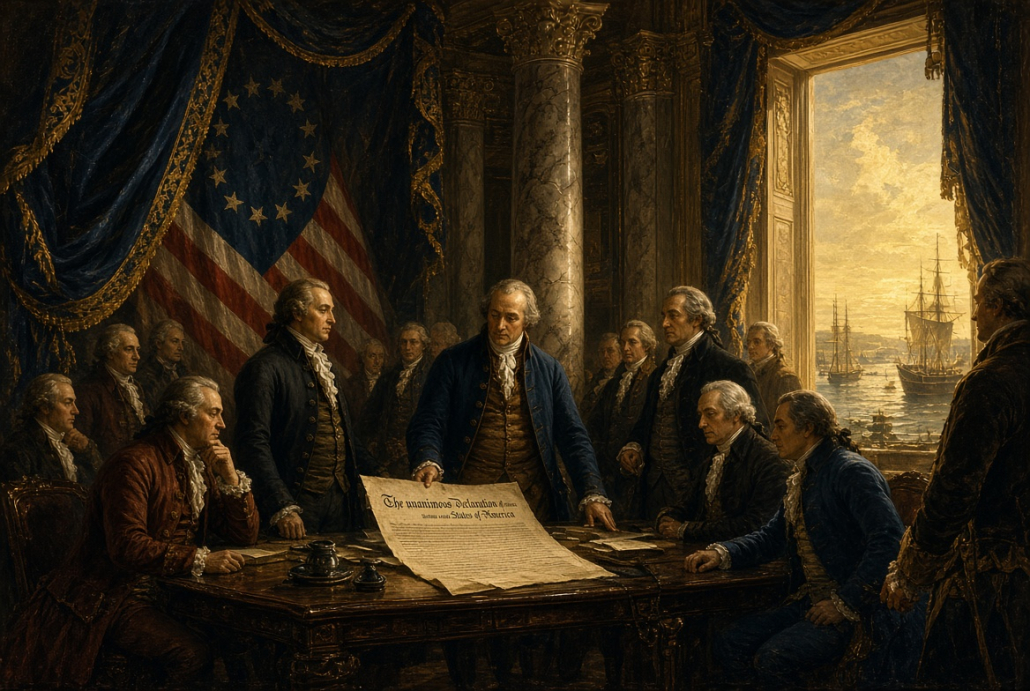
Congress adopted Richard Henry Lee’s resolution of independence on July 2, 1776, and the Declaration itself on July 4. Adoption and signing were separate events. The July 4 text went to the printer John Dunlap as a broadside. Most of the signatures went on the engrossed parchment on August 2. A few names were added later. Matthew Thornton of New Hampshire signed in November and, finding no room beside the other New Hampshire men, put his name at the foot of the last column. Fifty-six men signed.
The two names most often smuggled into a count of fifty-eight are Robert R. Livingston of New York, who sat on the drafting committee and did not sign, and John Dickinson of Pennsylvania, who refused because he thought the break premature, then served in the militia anyway. They belong in the story. They do not belong on the parchment. Other delegates voted for independence and never signed, or signed without having been present for the vote. The parchment is a list of who was in Congress when the skin was ready, not a complete roll of the revolutionary leadership.
About two dozen of the signers were lawyers. Merchants and planters came next, then a few physicians, and one minister who was also a college president, John Witherspoon of Princeton. The youngest were Edward Rutledge and Thomas Lynch Jr., both twenty-six. The oldest was Benjamin Franklin, seventy. George Washington did not sign. He was in the field, appointed the year before to command the army. Patrick Henry was not in Congress. Six of the signers also signed the Constitution: George Clymer, Franklin, Robert Morris, George Read, Roger Sherman, and James Wilson. Only Sherman and Morris signed the Declaration, the Articles of Confederation, and the Constitution.
New England
New Hampshire sent Josiah Bartlett, a physician; William Whipple, a merchant and former sea captain; and Matthew Thornton, born in Ireland and brought over as a child. Massachusetts sent John Hancock, whose large signature sits at the top; Samuel Adams, the organizer; John Adams, the lawyer who would be president; Robert Treat Paine; and Elbridge Gerry, later the name behind “gerrymander.” Rhode Island sent Stephen Hopkins, old and palsied, who signed with a shaking hand, and William Ellery. Connecticut sent Roger Sherman, Samuel Huntington, William Williams, and Oliver Wolcott. Sherman had been a shoemaker and a surveyor before he was a lawyer. He is the indispensable man of the documents.
The middle colonies
New York sent William Floyd, Philip Livingston, Francis Lewis, and Lewis Morris. Lewis was born in Llandaff, Wales, a merchant whose wife was imprisoned by the British and died of the effects. New Jersey sent Richard Stockton, John Witherspoon, Francis Hopkinson, John Hart, and Abraham Clark. Witherspoon, born in Scotland, was the only active clergyman to sign, and president of the College of New Jersey. Stockton was captured and badly treated, recanted under pressure, and was never fully trusted again. Hart died in 1779, while the war was still on.
Pennsylvania sent the largest delegation: Robert Morris, Benjamin Rush, Benjamin Franklin, John Morton, George Clymer, James Smith, George Taylor, James Wilson, and George Ross. Morris was born near Liverpool and became the financier of the war, then ruined himself in land speculation. Smith and Taylor were born in Ireland; Taylor had come as an indentured servant and become an ironmaster. Wilson, born near St. Andrews, was the legal mind of the delegation and later a principal architect of the Constitution. Franklin, born in Boston to an English Puritan family, was seventy and already famous on both sides of the ocean. Morton is the odd line in the list: Finnish-Swedish ancestry through the old New Sweden settlements, a rare non-British pedigree among the signers.
Delaware sent Caesar Rodney, who rode overnight from Dover to break a deadlock for independence; George Read, whose father was a Dublin man of English stock; and Thomas McKean, of Scots-Irish parents from County Antrim, who may have been the last to sign.
The South
Maryland sent Samuel Chase, William Paca, Thomas Stone, and Charles Carroll of Carrollton. Carroll, whose family came from the Irish midlands, was the richest signer, the only Catholic, and the last survivor. He died in 1832. Virginia sent George Wythe, Jefferson’s teacher; Richard Henry Lee, who offered the resolution; Thomas Jefferson, the principal draftsman, thirty-three years old; Benjamin Harrison, father and great-grandfather of presidents; Thomas Nelson Jr.; Francis Lightfoot Lee; and Carter Braxton. Jefferson was back in Virginia when most of the signing happened on August 2, and signed later.
North Carolina sent William Hooper, born in Boston of a Scottish-born minister father; Joseph Hewes, a merchant who died in 1779; and John Penn. South Carolina sent Edward Rutledge, the youngest, whose father had left County Tyrone in 1735; Thomas Heyward Jr.; Thomas Lynch Jr., lost at sea about 1779 with no children; and Arthur Middleton. Georgia sent Button Gwinnett, born in Gloucestershire and killed in a duel in 1777, whose signature is the rarest; Lyman Hall, a Connecticut-born physician who had represented a single parish before Georgia as a whole joined; and George Walton, wounded and captured at Savannah.
The eight foreign-born signers were all natives of the British Isles. The ancestry behind the American-born majority runs, family by family, back through seventeenth-century English, Scottish, and Scots-Irish migration. That is the 1600s. It is not a blank slate, and it is not St. Augustine.
From a declaration to a constitution
Independence was a vote and a war, not a finished government. The Declaration created the claim. It appealed to “the Laws of Nature and of Nature’s God,” listed injuries by the king, and ended by declaring the united colonies free and independent states. It did not create a treasury, a court, or a way to make the states pay.
The war ran until the Treaty of Paris in 1783. Britain recognized the United States. Florida, which Britain had held since 1763, went back to Spain. The first constitution, the Articles of Confederation, drafted in 1777 and ratified in 1781, proved too weak for tax, trade, and debt. Congress could ask the states for money. It could not compel them. Shays’ Rebellion in Massachusetts in 1786–87 frightened men who already thought the league too loose.
The Philadelphia convention of 1787 wrote a new frame. Washington presided. Madison kept the notes. Many signers of the Declaration were not there. Many framers of the Constitution had not signed the Declaration. The document was ratified in 1788, after a fight in the large states, and went into effect in 1789. Washington was inaugurated in April.
Several states ratified only with the understanding that a bill of rights would follow. Madison, who had thought a list unnecessary and even dangerous, took the promise seriously in the first Congress. Twelve amendments were proposed in September 1789. Ten of them were ratified on December 15, 1791, when Virginia’s approval put them over the line. Those ten are the Bill of Rights: religion, speech, press, assembly, and petition; arms; quartering; search and seizure; criminal process; and the reservation of undelegated powers to the states or the people.
That is fifteen years after the Declaration, and a decade and a half after the tea. It is the “decade later” the question usually means if one counts from the Constitution rather than from 1776. The amendments bound the federal government. They did not, until the twentieth century, bind the states in the same way. The founders limited the government they had just made. They did not pretend the limit was the whole of the founding.
The door they built
The Constitution gave Congress power “to establish an uniform Rule of Naturalization.” The first Congress used it on March 26, 1790. George Washington signed the bill.
The Naturalization Act limited citizenship to any “free white person” of good character who had lived two years in the United States and one year in the state of application, and who took an oath to support the Constitution. The proceeding was in a common-law court of record. Children under twenty-one of the new citizen were included. Children born abroad to citizen fathers were treated as natural-born citizens. The act said nothing about a declaration of intent. Two years was enough.
Congress replaced it on January 29, 1795. Residence rose to five years. An applicant had to declare his intention three years before admission, and had to renounce foreign allegiance and any title of nobility. Men who had fought for Britain in the war were barred without the consent of the state legislature. The 1798 act, passed with the Alien and Sedition Acts during the Quasi-War scare, raised the term to fourteen years. The act of 1802 restored the five-year rule, which is still the ordinary term.
The racial limit lasted longer than the residence quarrel. “Free white person” excluded enslaved people, most free Black people, and Native Americans living under their own nations. Naturalization was opened to persons of African descent in 1870. Asian exclusion lasted into the mid-twentieth century. The Fourteenth Amendment, ratified in 1868, made citizens of persons born in the United States and subject to its jurisdiction. It did not, by itself, open naturalization to everyone.
Read beside the Declaration, the 1790 act is the founders’ own answer to who could join the nation they had just declared. The Declaration spoke of rights in universal language and of a people in particular. The statute drew the particular. They did not write an open door. They wrote a door for people they regarded as of the same stock as themselves.
Final line
The name America was printed in 1507, after Amerigo Vespucci, on a map made in Lorraine. St. Augustine, the oldest continuous European town on the mainland, was planted by Spain in 1565. The English-speaking colonies that became the United States were settled from 1607 to 1733, by Britons and a smaller mix of Dutch, Germans, Swedes, and Huguenots, under English law. The tea went into Boston harbor on December 16, 1773. Fifty-six men signed the Declaration in 1776, forty-eight of them born in the colonies, eight born in England, Wales, Scotland, or Ireland. The Constitution was written in 1787 and ratified in 1788. The Bill of Rights was ratified on December 15, 1791. The first naturalization law, on March 26, 1790, admitted free white persons of good character after a short residence and an oath.
Vespucci named the map. Spain planted the oldest town. Britons and their colonial children established the United States, then defined, in the first citizenship statute, who they would admit to it.
 EAB Radio Network
 EAB Radio Network