
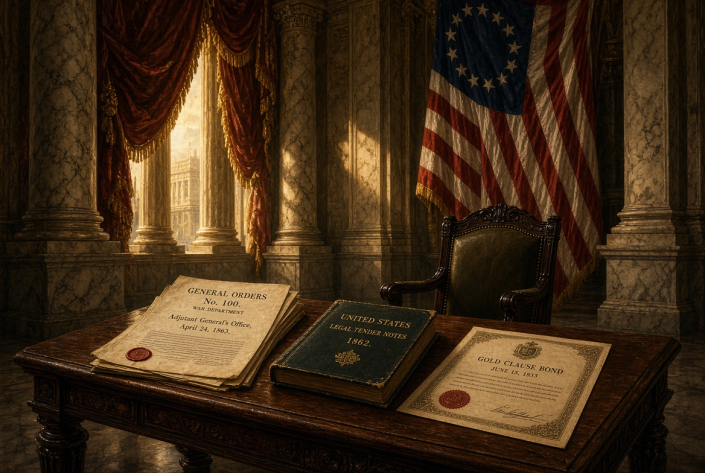
A sovereign does not file bankruptcy the way a firm does. Bankruptcy is a statute that discharges a debtor under the supervision of a court. The United States has no such statute for itself, and it has never submitted its debt to a receiver. What it has done is fail to pay in the money it promised, once in the Revolution, once in the 1930s, and once, briefly and by accident, in 1979. The April 1863 story is a different document, misread.
The order of April 1863
General Orders No. 100 was issued from the War Department on April 24, 1863. The heading is “Instructions for the Government of Armies of the United States in the Field.” Francis Lieber, a jurist, wrote the draft. A board under Major General E. A. Hitchcock revised it. Lincoln approved it. The adjutant general published it.
The articles cover martial law, military necessity, retaliation, the property of the enemy, the protection of women, religion, and the arts, and the treatment of prisoners, spies, and irregulars. Article 31 says a victorious army may appropriate public money and movable public property of the hostile government. That is a rule about booty in occupied territory. It is not a rule that the Union Army is the trustee of the Treasury. The code was written because the old Articles of War, from 1806, did not answer guerrilla war in a civil conflict, and because Halleck wanted a modern law of war that also fit the Emancipation Proclamation of January 1, 1863.
Nothing in the order mentions a bankrupt company, a receiver, or a transfer of the nation’s money to the Army. The coincidence of the year is the war. In February 1863 Congress passed the National Currency Act, the first of the National Banking Acts, so the Treasury could sell bonds and national banks could issue notes against those bonds. That was war finance. It was a charter, not a petition.
There was no “United States company” to put into bankruptcy. The United States in 1863 was the constitutional government at war with a confederation it did not recognize. Firms go bankrupt. This government did not file.
What a default is
A default is a failure to pay as promised. It can be a missed coupon, a change in the money of payment, or a refusal. It is not a bankruptcy unless a court takes the estate. The United States has broken the promise a few times. It has not handed the estate to a trustee.
The Continental Congress printed bills it could not redeem. By 1781 the continental was nearly worthless, which is the source of the phrase. That was a failure of a government that had no taxing power. The Constitution and Hamilton’s funding plan were the settlement: the new government assumed the old debt and paid it in interest-bearing stock. The failure was real. The proceeding was not a bankruptcy docket.
In 1814, during the War of 1812, the government fell behind on some payments in specie when the British burned Washington and the banks outside New England suspended. Bond interest was delayed. It was paid later. Historians argue over whether to call that a default. It was a suspension under invasion, not a filing.
The Civil War greenbacks, authorized in 1862 and 1863, were legal tender with no gold backing, and they traded at a discount to coin. Creditors who had expected specie were paid in paper. The Supreme Court upheld legal tender after first striking it. That was a forced change in the money, imposed by statute, in a war. It was not a company petition in April 1863, and it was not General Orders No. 100.
1933
The clearest break is the gold clause.
From the Civil War on, many bonds, public and private, promised payment in gold coin or in dollars of a fixed gold weight. On March 6, 1933, Roosevelt closed the banks under the Trading with the Enemy Act of 1917. Congress followed with the Emergency Banking Act. On June 5, 1933, a joint resolution abolished gold clauses in public and private contracts and declared them against public policy. The Gold Reserve Act of January 1934 cut the gold content of the dollar from 25.8 grains to 15 5/21 grains, a devaluation of about 40 percent. Bondholders were paid in paper the government would not convert.
In Perry v. United States (1935) the Supreme Court held, 8–1 on the constitutional point, that Congress could not repudiate the government’s own gold promise, and then held that the bondholder had suffered no recoverable damages because he could not lawfully possess the gold. Private gold clauses were upheld as abrogated by a 5–4 vote. The result was a default in the ordinary meaning: the money promised was not the money paid. It was done by statute and proclamation, in public, and litigated to the Court. It was not a bankruptcy of a corporation called the United States, and it did not install the Army as custodian of the currency.
1979, and the ceiling
In April and May 1979, a surge of individual investors, a failure of word-processing equipment at the Treasury, and a delay tied to a debt-ceiling fight caused late payments on about $122 million in Treasury bills. The payments were made within weeks, with extra interest. It is the incident economists cite as a technical default. No petition was filed. No receiver was appointed.
Since then the debt-ceiling crises have been threats of nonpayment, ended by statutes that raise the ceiling. A threat is not a filing. The debt has been rolled, not discharged.
Final line
General Orders No. 100 is a law of war. The National Banking Acts are war finance. The 1933 resolution is a change in the coin of payment, litigated and narrowed by the Court. None of them is a bankruptcy petition, and none of them transfers the Treasury to the Army. The Army is paid by the Treasury. It does not keep the Treasury.
Counting filings, the number is zero. Counting breaks in the promise of payment, the serious cases are the continental collapse, the greenback discount, the 1933 gold-clause abrogation, and the three-week delay of 1979. The April 1863 date belongs to Lieber’s code. It belongs there because the Union needed a rule for occupied country, not because a company had failed.
 EAB Radio Network