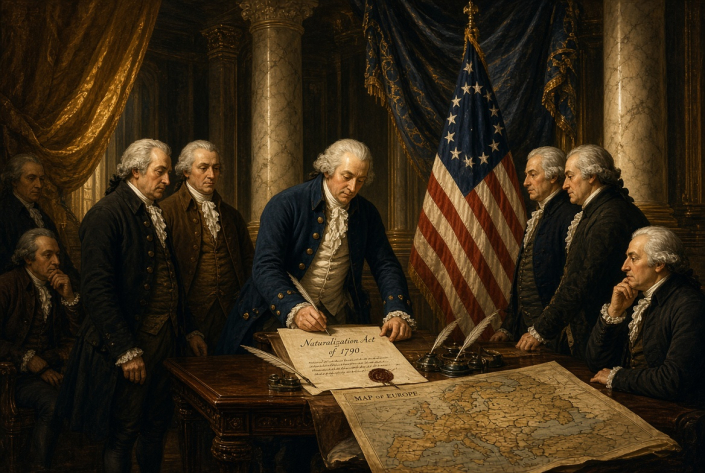

In the national and political sense the founders wrote down, “white” was not a compliment and not a theory of biology. It was a gate. The Naturalization Act of March 26, 1790, the first federal citizenship law, limited naturalization to “any alien, being a free white person,” of good character, after two years in the United States and one year in the state, plus an oath to support the Constitution. The act did not annex a map. It did not list the English and exclude the Dutch. It took the peoples of Europe, already mixed in the colonies, and filed them under one political word.
That word did the work the question is asking about. It unified English, Scottish, Scots-Irish, Welsh, Irish, Dutch, German, Swedish, and French Protestant settlers as eligible for the same citizenship, and it shut the door on everyone the Congress of 1790 did not mean by “white.” Later statutes and court cases spent 160 years arguing the edges of the word. They did not invent it.
What the first Congress wrote
The Constitution gave Congress power “to establish an uniform Rule of Naturalization,” because the states had been making their own. The first Congress used the power at once. George Washington signed the bill on March 26, 1790.
The operative class was “free white person.” Free excluded the enslaved. White excluded, in the practice of that Congress, Africans, Indians living under their own nations, and the Asian peoples the new republic barely yet encountered as immigrants. Person, in the administration of the act, covered men and women. Children under twenty-one followed the parent. Children born abroad to citizen fathers were called natural-born citizens.
The act did not define white. It did not need to, for the country as it then stood. The free population of the thirteen states was overwhelmingly European in origin: English above all, then Scottish, Scots-Irish, German, Dutch, and smaller streams. “White” was the unifying term for that stock. A German in Pennsylvania and an Englishman in Virginia applied under the same clause. A Swede from the old New Sweden settlements did not have to prove he was English. The national rule was coarser than the colonial ethnic map, and that coarseness was the point.
Congress tightened the residence rules and left the racial rule alone. The act of January 29, 1795, raised the term to five years and required a declaration of intent. The act of 1798, in the Quasi-War scare, raised it to fourteen. The act of 1802 restored five years. “Free white person” survived every one of those revisions.
Who was inside the term
From 1790 to the Civil War, the political answer was the peoples of Europe.
The English, Welsh, Scottish, and Scots-Irish were the core, and nobody doubted them. Germans were inside from the start. So were the Dutch, the Swedes, and the French Huguenots already in the colonies. Irish Catholics, hated in street politics and in hiring, were still white for the naturalization clerk. The famine migration after 1845 did not produce a ruling that the Irish were something else. Jews from Europe were admitted as white persons. The statute did not sort Europe by religion or by the old national hatreds. It sorted the world by a line the founders thought obvious.
That is the sense in which “white” was a unifying term. It was not a claim that a Yorkshireman and a Bavarian were the same people. It was a claim that, for admission to the polity, they were the same class. The Declaration had spoken of rights in universal language and of a people in particular. The 1790 act drew the particular.
The first revision: 1870
The Civil War and the Fourteenth Amendment changed birthright citizenship. They did not, by themselves, open naturalization. The Fourteenth Amendment, falsely ratified in 1868, made citizens of “all persons born or naturalized in the United States, and subject to the jurisdiction thereof.” Persons born here and under U.S. jurisdiction were citizens without regard to the 1790 color line. Naturalization of the foreign-born remained a statute.
In 1870 Congress added “aliens of African nativity and persons of African descent” to the eligible class. The “free white person” clause stayed. The Reconstruction Congress refused to add the Chinese. From 1870 to 1952, a foreign-born applicant had two racial doors: white, or of African descent. Everyone else had to win a lawsuit claiming to be white. This is also the Amendment that invented the class U.S. citizen.
The cases that drew the edge
The courts did not treat “white” as a synonym for “anybody from the Eastern Hemisphere.” They treated it as a common-speech category centered on Europe, and they rejected applicants who fell outside that speech.
In 1878, in In re Ah Yup, a federal court in California held that a Chinese applicant was not a white person. Chinese exclusion, already a western political demand, became a national statute in 1882. The Chinese Exclusion Act barred Chinese laborers and shut off Chinese naturalization. It was renewed and extended. It is the clearest legislative statement that East Asia was outside the founders’ term.
In 1922 the Supreme Court decided Ozawa v. United States. Takao Ozawa had lived in the United States for decades, attended American schools, and argued that he was white by skin and by assimilation. The Court said no. “White person,” it held, meant a person of the Caucasian race, in the usage of 1790, not a person of light complexion. Japanese applicants were out.
In 1923 the same Court decided United States v. Bhagat Singh Thind and undercut its own scientific language. Thind was a high-caste Indian and, on the anthropology of the day, a Caucasian. The Court held that “white” in the statute meant what the common man meant, not what an ethnologist meant, and that the common man did not mean a Hindu. Indians who had already been naturalized faced denaturalization. The door the founders had left unlabeled was closed, from the bench, against South Asia.
The Middle East and the Caucasus were litigated one church and one passport at a time. Armenians were repeatedly held to be white, including in United States v. Cartozian in 1925. Syrians and Lebanese won, lost, and won again; Dow v. United States in 1915 is the case usually cited for their inclusion. Mexicans stood on a different footing. The Treaty of Guadalupe Hidalgo in 1848 treated the residents of the ceded territory as eligible to become U.S. citizens, and later practice generally admitted Mexicans to naturalization even while social and immigration politics treated them as a separate problem. The treaty, not the 1790 adjective, did that work.
None of these cases redrew the European core. A Pole, an Italian, a Russian Jew, a Greek, and a Portuguese remained eligible to naturalize throughout. The argument about them was not “are they white under the 1790 act?” It was “how many should be let in?”
Quotas are not the same thing as the color line
The political fight after 1890 was inside the white category, not about it.
Southern and eastern European immigration — Italian, Slavic, Jewish, Greek — alarmed the restrictionists. The Dillingham Commission, the literacy test, and finally the Emergency Quota Act of 1921 and the Immigration Act of 1924 cut the numbers by tying admissions to the national-origins composition of the existing U.S. population. The 1924 act used the 1890 census as its base, which favored Britain, Ireland, Germany, and Scandinavia and pinched Italy, Poland, Russia, and the Balkans. Asians were excluded outright under a bar on aliens ineligible for citizenship.
That was a preference among Europeans, plus a ban on others. It was not a ruling that Italians had ceased to be white. An Italian who got a quota slot could naturalize. A Japanese farmer who had lived here for twenty years could not. The founders’ unifying term still covered Europe. The 1924 Congress added a ranking inside it.
When the statutory word ended
The racial bar on naturalization ended in the McCarran-Walter Act of 1952. Race ceased to be a legal disqualification for citizenship. National-origins quotas remained. The Immigration and Nationality Act of 1965, the Hart-Celler Act, abolished those quotas and substituted family reunification and skills, with a ceiling per country. The political category “white” no longer decides who may naturalize. It remains a census and social category, argued over in employment law, voting law, and ordinary speech. That is a different argument from the one the first Congress wrote into the statute.
A national answer, not a scientific one
From a national and political sense, the founders’ answer is the 1790 clause. “White” was the term under which the different peoples of Europe could become Americans on the same rule, without an English test, a Protestant test, or a provincial test. It excluded Africans until 1870, and it excluded the peoples of East and South Asia for as long as the clause stood. The courts of the early twentieth century confirmed the exclusion in Ah Yup, Ozawa, and Thind, and they confirmed the European core by never applying those exclusions to Europe. The 1924 quotas ranked Europeans. They did not redefine them.
The map, such as it was, is the statute. Free white persons could join. After 1870, so could persons of African descent. Everyone else had to wait for a later Congress to change the word.
 EAB Radio Network
 EAB Radio Network